
 By
By Best Christian Books for Anxiety and Depression
“The Lord is close to the brokenhearted and saves those who are crushed in spirit.” — Psalm 34:18
If you found this article, you are probably carrying something heavy. Maybe it is the quiet weight of anxiety that follows you into every room. Maybe it is the deeper darkness of depression — the kind that makes getting out of bed feel like climbing a mountain. Or maybe you are simply exhausted in a way that no amount of sleep has fixed in months.
Whatever brought you here: you are not spiritually weak. You are not failing God. You are human — and the Bible is full of people who felt exactly what you are feeling right now. Elijah burned out under a broom tree and asked God to take his life. David wept his way through the Psalms. Jesus himself was “overwhelmed with sorrow to the point of death” in Gethsemane.
Lament is not the opposite of faith — it is often the most honest expression of it. If you need immediate grounding in Scripture, our Bible verses for strength and Bible verses for tough times are a good place to start.
The right book will not cure a clinical disorder. But it can remind you that you are not alone, give language to what hurts, and point you back to the God who meets us in the valley. These are the best Christian mental health resources available today — 16 books, grouped by what you need most right now.
Practical & Modern: Books That Meet You Where You Are
These books are written by contemporary authors who take both Scripture and psychology seriously. They are accessible, honest, and refreshingly free of religious clichés. If you are new to this space or just need something readable and immediately helpful, start here.
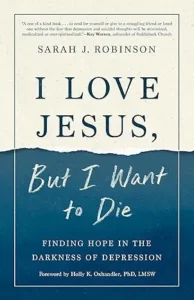
1. I Love Jesus, But I Want to Die — Sarah J. Robinson
Sarah J. Robinson does what few Christian authors dare to do — she names suicidal ideation plainly, without shame and without spiritualizing it into something tidy. This book is a lifeline for Christians experiencing a mental health crisis who feel guilty for struggling. Robinson holds psychology and faith together with skill and compassion, dismantling the harmful idea that more prayer is always the answer to a clinical illness.
Key Takeaway
Seeking professional mental health treatment is not a lack of faith — it is wisdom. Your brain is an organ, and caring for it is an act of stewardship, not surrender.
Best for: Anyone experiencing depression, suicidal thoughts, or who feels shame around struggling mentally as a Christian.
→ Check price & availability on Amazon
2. Anxious for Nothing — Max Lucado
Max Lucado builds this entire book around a single passage: Philippians 4:6–7. With his trademark warmth and accessibility, he unpacks what it practically looks like to bring anxiety to God — through celebration, supplication, and gratitude — and receive the peace that passes understanding in return.
This is not a book that minimizes anxiety; it is one that offers a grounded, biblical pathway through it. As one of the most widely recommended Christian mental health resources, it earns its place on every list.
Key Takeaway
Anxiety is not a sin — but it is an invitation. Every anxious moment is a prompt to pray. The practice of turning worry into prayer, consistently and specifically, rewires the soul over time.
Best for: Christians who are new to faith-based approaches to anxiety and want something warm, simple, and directly applicable.

→ Check price & availability on Amazon
3. Get Out of Your Head — Jennie Allen
Jennie Allen’s premise is bold: the greatest spiritual battle of our generation is fought in the mind. Drawing on neuroscience and Scripture together, she teaches readers how to interrupt toxic thought spirals and replace them with intentional, God-directed thinking.
The book is energetic, practical, and written for people who feel trapped inside their own heads — which describes most people dealing with anxiety and depression. For more books written specifically for women navigating faith and emotion, see our roundup of the best Christian women’s books.
Key Takeaway
You cannot always choose your circumstances, but you can choose where your thoughts go. Romans 12:2 is not a platitude — it is a neurological possibility that requires daily, deliberate practice.
Best for: Christians who struggle with rumination, intrusive thoughts, and mental loops they cannot seem to break.

→ Check price & availability on Amazon
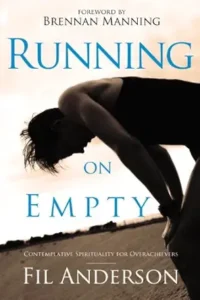
4. Running on Empty — Fil Anderson
Fil Anderson was a successful Christian ministry leader who hit a wall — not a dramatic collapse, but a slow, creeping emptiness that snuck up on him over years of doing good things for the wrong reasons.
Running on Empty is his honest reckoning with that experience and an invitation to others running on fumes. He argues that true spiritual health is not found in more activity but in a deeper encounter with a God who loves us regardless of our output. This is essential reading for the burned-out Christian who cannot figure out why they feel so dead inside.
Key Takeaway
Busyness is not the same as fruitfulness. If your soul is depleted, no amount of Christian service will refill it — only honest rest and honest relationship with God can do that.
Best for: Ministry leaders, volunteers, and high-achieving Christians who feel hollow despite doing “all the right things.”
→ Check price & availability on Amazon
As you read these books, let Scripture run alongside them. Our collection of Bible Verses About Faith covers 45 passages for every season of doubt and trust — a perfect companion to the practical books above.
Theological & Deep: Books That Give Your Suffering a Framework
Sometimes comfort is not enough. Sometimes you need to understand — to have a theology of suffering that actually holds up when life falls apart. These books provide that depth. They are not light reads, but they are worth every page.
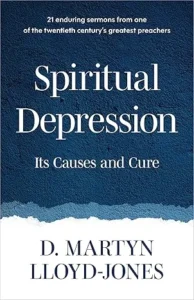
5. Spiritual Depression: Its Causes and Its Cure — D. Martyn Lloyd-Jones
Written in 1965 and still unmatched in its category, Lloyd-Jones — a medical doctor turned minister — diagnoses spiritual depression with surgical precision. He identifies over a dozen distinct causes of spiritual despondency, from temperament and physical constitution to unconfessed sin to a fundamental misunderstanding of the gospel.
This is not a pop-psychology book. It is rigorous, Reformed, and deeply pastoral, offering genuine biblical hope for depression rooted in a robust understanding of God’s grace.
Key Takeaway
Lloyd-Jones’ most famous insight: “The main art in the matter of spiritual living is to know how to handle yourself. You have to take yourself in hand, address yourself, preach to yourself, question yourself.” Stop listening to your feelings and start speaking truth to them — out loud if necessary.
Best for: Christians with a theological bent who want to understand the root causes of depression, not just manage the symptoms.
→ Check price & availability on Amazon
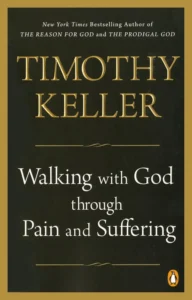
6. Walking with God Through Pain and Suffering — Timothy Keller
Tim Keller was no stranger to suffering — he battled cancer and faced it with the same intellectual rigor he brought to everything else. This book surveys how every major worldview handles pain, shows where they fall short, and makes a careful, moving case for why the Christian gospel is uniquely equipped to provide both comfort and meaning in suffering.
It is one of the most complete theological treatments of the subject written in modern times, blending philosophy, theology, and pastoral care into a single volume.
Key Takeaway
Christianity does not promise immunity from suffering — it promises presence in it, purpose through it, and transformation because of it. That is a fundamentally different offer from anything else on the market.
Best for: Those whose depression or anxiety is tangled up with grief, loss, or unanswered prayer, and who need their faith to withstand serious intellectual scrutiny.
→ Check price & availability on Amazon
7. The Problem of Pain — C.S. Lewis
C.S. Lewis wrote this book before his own great suffering (the death of his wife Joy, chronicled in A Grief Observed), which makes it both brilliant and, by his own later admission, somewhat too tidy. But as an intellectual framework for why a good God allows pain, it remains essential.
Lewis dismantles the sentimental idea that God’s love means God’s comfort, and replaces it with a more demanding and ultimately more satisfying vision: a God who loves us enough to use suffering to shape us into something worthy of eternity.
Key Takeaway
“God whispers to us in our pleasures, speaks in our conscience, but shouts in our pain: it is his megaphone to rouse a deaf world.” Pain is not evidence against God — it may be evidence of him.
Best for: Intellectually-minded Christians who need their theology of suffering stress-tested before they can lean on it.

→ Check price & availability on Amazon
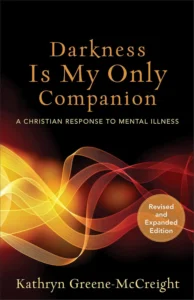
8. Darkness Is My Only Companion — Kathryn Greene-McCreight
This is one of the most theologically sophisticated and personally raw books ever written about mental illness from a Christian perspective. Greene-McCreight is an Episcopal priest and theologian who has lived with bipolar disorder and survived multiple hospitalizations.
She writes from inside the experience — not looking back from a safely recovered distance — and she holds the reality of severe mental illness alongside robust Anglican theology without flinching. This is not an easy read. It is a necessary one.
Key Takeaway
Mental illness is not a spiritual failure. It is a condition of our fallen creaturely existence — and the Church’s calling is not to explain it away but to sit with those enduring it, as Job’s friends should have done.
Best for: Pastors, caregivers, and those with serious mental illness who want theological depth paired with lived experience — not managed from a comfortable distance.
→ Check price & availability on Amazon
Trauma-Informed: Books That Honor Your Nervous System
Not all anxiety and depression has a purely spiritual or cognitive cause. Sometimes it is stored in the body — the result of trauma, chronic stress, or a nervous system that never learned it was safe. These books take that reality seriously, integrating neuroscience, somatic therapy, and Christian faith in ways that are both credible and deeply pastoral.
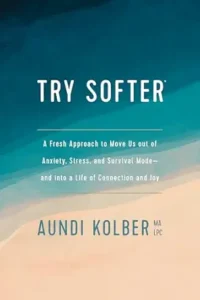
9. Try Softer — Aundi Kolber
Licensed therapist Aundi Kolber brings a trauma-informed, somatic (body-based) approach to Christian healing. She gently dismantles the “try harder” mentality that quietly poisons many Christian communities — the assumption that if you just prayed more, served more, or trusted more, you would feel better.
Kolber argues instead for attunement: learning to listen to your body, honor your limits, and let God meet you in your nervous system, not just your theology. Try Softer is one of the most important Christian mental health resources published in the last decade. If this resonates, also read our piece on finding strength in the storm.
Key Takeaway
Your body is not the enemy of your faith. It is the temple of the Holy Spirit, and it holds stories your mind has not yet processed. Healing often requires gentleness — not more effort.
Best for: Christians who have experienced trauma, burnout, chronic stress, or who feel disconnected from their own bodies and emotions.
→ Check price & availability on Amazon
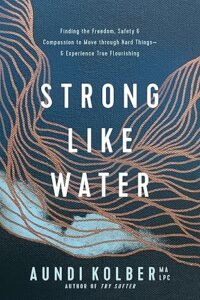
10. Strong Like Water — Aundi Kolber
Kolber’s follow-up to Try Softer expands the conversation into a more sustained exploration of what it actually means to be strong in a human, embodied way — as opposed to the brittle, performative strength that trauma and religion can sometimes produce.
Drawing on the image of water — which is both powerful and adaptive — she invites readers into a faith that is resilient without being rigid, and tender without being fragile. It is a perfect second step for anyone who found Try Softer transformative.
Key Takeaway
True strength does not mean never breaking. It means having the internal resources — and the God-given support — to bend without shattering, and to find your way back to yourself when you do.
Best for: Those who have begun trauma-informed healing and are ready to move from survival mode into a more integrated, flourishing life.
→ Check price & availability on Amazon
11. A Grace Disguised — Jerry Sittser
In a single car accident, Jerry Sittser lost his mother, his wife, and his young daughter. A Grace Disguised is what he wrote afterward — not a recovery manual, but an honest descent into grief and what he found at the bottom of it.
The book does not rush toward resolution. It insists on sitting in the dark long enough to let God meet you there. Sittser’s central claim is quietly revolutionary: the experience of loss itself, rather than recovery from it, can become the means of grace. If you are walking through grief right now, our Bible verses for hard times may offer some grounding alongside this book.
Key Takeaway
“The quickest way for anyone to reach the sun and the light of day is not to run west, chasing after the setting sun, but to head east, plunging into the darkness until one comes to the sunrise.” Running from pain prolongs it. Entering it, with God, transforms it.
Best for: Those whose depression or anxiety is rooted in grief, loss, or a catastrophic life event that still feels impossible to absorb.

→ Check price & availability on Amazon
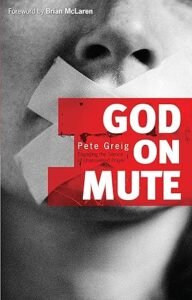
12. God on Mute — Pete Greig
Pete Greig, founder of the global 24-7 Prayer movement, wrote this book after watching his wife Sammy suffer a devastating brain condition despite thousands of people praying for her healing. God on Mute is his unflinching reckoning with unanswered prayer — the Saturday between Good Friday and Easter Sunday, as he calls it, when God seems absent and heaven seems silent.
It is one of the bravest, most honest books a prominent Christian leader has ever written about the gap between what we believe and what we experience. Holding onto Bible verses about trusting God can be a helpful anchor while reading this one.
Key Takeaway
Unanswered prayer is not proof that God is absent. It may be proof that we are in Holy Saturday — that in-between space that requires a faith strong enough to wait in the dark for a Sunday that has not arrived yet.
Best for: Christians who feel abandoned by God in their depression or illness, especially those whose prayers have not been answered in the ways they hoped.
→ Check price & availability on Amazon
Need a spark of courage between chapters? These Motivational Bible Verses gather the most powerful declarations of hope in Scripture — words that rise up when your own words fail.
Devotional & Habit-Based: Books That Restructure Your Daily Life
Sometimes anxiety and depression are fed by the patterns of how we live — the pace, the noise, the disconnection from God and from ourselves. These books help you build rhythms that actually sustain the soul. They are practical, grounded in ancient Christian wisdom, and oriented toward long-term change rather than quick fixes.
13. Consider the Lilies — Jonny Ardavanis
Drawing directly from Jesus’ words in Matthew 6 — “Consider the lilies of the field, how they grow; they neither toil nor spin” — Jonny Ardavanis writes a pastoral, Scripture-saturated guide for the anxious Christian.
Rather than offering therapeutic techniques alone, Ardavanis anchors every chapter in the character of God: his sovereignty, his provision, and his attentiveness to the small things.
This book is quietly countercultural — it calls us back to trust in a God who holds the universe and still notices every sparrow. Pair it with our guide on finding peace in Jesus Christ for a fuller devotional experience.
Key Takeaway
Anxiety often flows from a functional belief that God is not paying attention — or that we must secure our own futures. The antidote is not willpower but wonder. Looking at what God sustains, we slowly learn to trust that he will sustain us too.
Best for: Christians who struggle with anxious thought patterns and who need a devotional approach rooted in solid theology and the character of God.

→ Check price & availability on Amazon
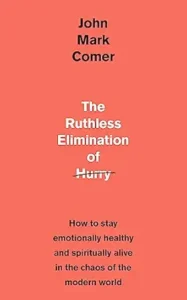
14. The Ruthless Elimination of Hurry — John Mark Comer
John Mark Comer argues — persuasively and with historical depth — that hurry is not merely a time management problem but a spiritual disease. The frenetic pace of modern life is incompatible with the way of Jesus, and soul health requires radical, deliberate slowness.
The ancient spiritual disciplines he recommends (Sabbath, silence, solitude, simplicity) are not add-ons for the spiritually advanced — they are the baseline for anyone serious about overcoming anxiety with faith. Crucially, these same practices are also some of the most evidence-based anxiety interventions in the psychological literature. Building a consistent daily devotion habit is a natural companion practice to everything Comer teaches.
Key Takeaway
You cannot run at the speed of the internet and walk in the way of Jesus at the same time. Something has to give — and it is usually your peace.
Best for: Busy, high-capacity Christians who sense that their pace of life is making them worse — spiritually and mentally — but do not know how to slow down without feeling guilty.
→ Check price & availability on Amazon
15. Emotionally Healthy Spirituality — Peter Scazzero
Peter Scazzero’s central thesis is provocative: it is not possible to be spiritually mature while remaining emotionally immature. Many Christians have deep theological knowledge and active ministry involvement while simultaneously being unable to handle conflict, name their own feelings, or maintain healthy relationships.
Scazzero — drawing on contemplative Christian tradition, psychology, and his own pastoral failures — shows how emotional health and spiritual health are inseparable. For Christians struggling with anxiety or depression, this book often names something they have sensed for years but could never articulate.
If you want to keep exploring, our list of 22 powerful Christian books to deepen your relationship with God has excellent companion reads.
Key Takeaway
You will not grow past your emotional health. The unexamined wounds, patterns, and false selves we bring into our faith will quietly undermine everything we try to build on top of them.
Best for: Christians who are theologically solid but emotionally stuck — who have grown in knowledge but not in self-awareness, and who sense the gap but do not know how to close it.

→ Check price & availability on Amazon
16. When God Weeps — Joni Eareckson Tada & Steve Estes
Joni Eareckson Tada has lived as a quadriplegic since a diving accident at age seventeen. She has also lived with chronic pain, depression, and breast cancer — all while becoming one of the most influential disability advocates and Christian voices of the last half-century.
When God Weeps, co-written with Steve Estes, is her theological reckoning with suffering: why God allows it, what it accomplishes, and how to find him trustworthy when the pain does not stop. It is not theory. It is hard-won, lived-in biblical hope for depression and suffering from someone who has no easy outs. Stand alongside this book with our compilation of God’s promises of healing.
Key Takeaway
“God permits what he hates to accomplish what he loves.” Suffering is not outside God’s sovereign care — but it is also not something he watches passively. He enters it. He weeps in it. And he works through it in ways we may not see until eternity.
Best for: Those with chronic illness, physical disability, or long-term suffering who need a theology of pain that has actually been tested by fire.
→ Check price & availability on Amazon
A Final Word: You Are Allowed to Get Help
Books are a beginning. They open doors, give language to what hurts, and light the path ahead. But they are not a substitute for professional care — and good theology never pretends they are.
If you are experiencing clinical depression, persistent anxiety, or any crisis of mental health, please do the following:
- See a doctor. A psychiatrist or your primary care physician can evaluate whether there is a biological component that needs medical treatment. The brain is an organ. Treating it is not unspiritual.
- See a therapist. A licensed counselor — ideally one who integrates faith and psychology — can walk with you in ways no book can. The work of healing often requires another human being in the room.
- Tell someone. A pastor, a trusted friend, a family member. Isolation amplifies darkness. Let someone in. You do not have to carry this alone.
Seeking help is not a failure of faith. Proverbs 11:14 says that “victory is won through many advisers.” Your healing does not have to be a solo project — and neither does your faith.
The God who is “close to the brokenhearted” (Psalm 34:18) is not waiting for you to get better before he draws near. He is already in the valley with you. These books — and the professionals, pastors, and people in your life — are some of the ways he reaches toward you. And if you need a reminder on the hardest days: don’t give up — God will make a way.
If you are in the waiting — waiting for relief, for clarity, for God to move — these Bible Verses About God’s Timing speak directly to that space. His timing is not indifference. It is sovereignty.
Keep going. You are not alone.
Quick Reference: Best Christian Books for Anxiety and Depression
| Book | Author | Category | Best For |
|---|---|---|---|
| I Love Jesus, But I Want to Die | Sarah J. Robinson | Practical / Modern | Depression, crisis, shame |
| Anxious for Nothing | Max Lucado | Practical / Modern | Anxiety, prayer, beginners |
| Get Out of Your Head | Jennie Allen | Practical / Modern | Rumination, toxic thought patterns |
| Running on Empty | Fil Anderson | Practical / Modern | Burnout, ministry depletion |
| Spiritual Depression | D. Martyn Lloyd-Jones | Theological / Deep | Root causes, Reformed theology |
| Walking with God Through Pain and Suffering | Timothy Keller | Theological / Deep | Grief, loss, unanswered prayer |
| The Problem of Pain | C.S. Lewis | Theological / Deep | Intellectual faith, suffering framework |
| Darkness Is My Only Companion | Kathryn Greene-McCreight | Theological / Deep | Serious mental illness, pastoral care |
| Try Softer | Aundi Kolber | Trauma-Informed | Trauma, body-based healing |
| Strong Like Water | Aundi Kolber | Trauma-Informed | Post-trauma flourishing |
| A Grace Disguised | Jerry Sittser | Trauma-Informed | Grief, catastrophic loss |
| God on Mute | Pete Greig | Trauma-Informed | Unanswered prayer, spiritual abandonment |
| Consider the Lilies | Jonny Ardavanis | Devotional / Habit-Based | Anxiety, God’s character, trust |
| The Ruthless Elimination of Hurry | John Mark Comer | Devotional / Habit-Based | Pace, spiritual disciplines, anxiety |
| Emotionally Healthy Spirituality | Peter Scazzero | Devotional / Habit-Based | Emotional immaturity, self-awareness |
| When God Weeps | Joni Eareckson Tada & Steve Estes | Devotional / Habit-Based | Chronic illness, long-term suffering |