
 By
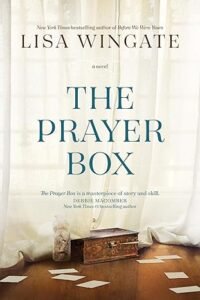
By The Prayer Box by Lisa Wingate – Book Summary
She was running. That much Tandi Jo Reese knew. Running from a man who had taken years of her life and left her with two children, a battered sense of self, and a bruised certainty that people like her don’t get second chances — that the label the world has placed on you is the one that sticks. She ended up on the windswept Outer Banks of North Carolina, in a rented cottage behind a crumbling Victorian house, telling herself it was only temporary. That she would move on before anyone noticed her. That she was invisible.
She did not expect Iola Anne Poole.
She did not expect eighty-one prayer boxes.
The Prayer Box, published in 2013 and the first book in Lisa Wingate’s Carolina Heirlooms series, is the kind of novel that does its deepest work quietly — tucking its most important truths into hand-lettered boxes and worn scraps of paper, the way a faithful old woman tucks her whole life into prayer. It is a story about two women who never properly meet. One has just died. The other is barely living. And yet across decades, across secrets held so long they became stone, across the impossible distance between despair and belief — they find each other. And both of them have changed. Check it
The Central Argument
Lisa Wingate has said that the recurring theme of The Prayer Box is grace — “what it is, how it changes lives, how we discover it, accept it, and pour it out to one another.” But the novel goes beyond naming grace as a theme. It incarnates it. It shows grace as a practice, a discipline, a daily choice made in the dark when no one is watching — and then shows what happens when that practice, accumulated over a lifetime, is discovered by someone who has never believed grace could apply to her.
The book’s organizing question is one that every reader who has ever felt stuck or shamed or too far gone will recognize: Can a life that has been defined by the wrong choices, the wrong people, and the wrong labels be genuinely remade? Wingate’s answer, delivered through the most concrete possible literary device — a collection of handwritten letters sorted into decorated cardboard boxes — is not a sermon. It is a story. And stories, Wingate understands, reach places that sermons cannot.
At their core, Tandi and Iola share the same bruised history. Both have survived the cruelty of untrustworthy people, and both carry the weight of being outcasts. It is this shared experience of marginalization and pain that ultimately connects their journeys across the decades.
The difference between them is not that one was lucky and one was not. It is that Iola chose not to accept the painful labels people had assigned to her, and instead chose to accept only one identity: beloved. Tandi’s entire journey — through the pages of Iola’s letters, through the salt air of the Outer Banks, through the slow rebuilding of her relationship with her children and her own soul — is the journey from self-condemnation to that same word. Beloved.
The Story: Two Lives, One House, Eighty-One Years of Letters
The Discovery. Tandi arrives in Rodanthe on North Carolina’s Outer Banks with nothing but her two children — fourteen-year-old Zoey and nine-year-old J.T. — and a desperate need to disappear. She has fled Trammel Clarke, an abusive ex-boyfriend whose shadow still falls over every decision she makes. Iola Poole, the elderly woman who owns the Victorian house next door and the cottage Tandi rents, has shown her unusual kindness. Then one day Tandi enters the house to check on her and finds Iola’s body. She has died alone, as quietly and unremarkably as she lived.
What Tandi finds in that house changes everything. In an upstairs turret room, in a hidden closet, are eighty-one carefully decorated prayer boxes — one for each year of Iola’s life, from the 1930s to the present day. Inside each box are letters Iola wrote to her “Father.”There is no polish here, no performance for an audience. These letters are raw, honest, sometimes joyful, and other times heavy with grief—conversations with God in their purest form. They represent the private archives of a woman who realized early in life that the only place she could safely speak her truth was on a scrap of paper, folded up, and given away.
Tandi begins to read them, and in reading them, begins to see.
Iola’s Story: Secrets Held for a Lifetime.
As Tandi explores the prayer boxes chronologically, she uncovers Iola’s extraordinary, hidden legacy. Iola’s 1930s childhood letters reveal her heritage as the granddaughter of Benoit House’s original owner and a Creole housekeeper. Because the “one-drop rule” of that era demanded concealment, her mixed-race identity remained a closely guarded secret.
At a New Orleans mission school, Sister Marguerite gifted Iola her first prayer box, advising her to put her feelings into words. This simple practice transformed prayer from a passive plea into an active, empowering narrative—a lifelong discipline that sustained her through immense personal trials.
During World War II, Iola enlisted in the Women’s Army Auxiliary Corps, courageously navigating the strict social barriers of her time. Though she later faced profound heartbreak when her secret marriage ended after the tragic loss of her child, her resilience never wavered.
She eventually returned to her ancestral home, Benoit House. While her neighbors harbored decades of unfounded suspicion, Iola quietly championed their welfare. She privately sold antiques to anonymously fund local families, turning her birthright into a sanctuary of generosity for the very community that misunderstood her.
Ultimately, these prayer boxes document a brilliant lifetime of quiet, active service. Iola proved that true prayer culminates in tangible kindness—whether through a timely gift to a family recovering from a storm or a small token of appreciation for a local worker. By transforming written intentions into purposeful action, Iola established a legacy of hope, proving that faith shines brightest when put into motion.
Tandi’s Story: The Long Road Back.
As Tandi reads through Iola’s life, her own begins to heal. Working at a local seashell shop, she finds a supportive community of women who accept her without question. Drawing on skills from her grandfather—the lone stable figure in her chaotic childhood—she starts repairing her life, her relationships, and her bond with her children.
However, her relationship with her rebellious daughter, Zoey, remains strained. When Tandi’s glamorous but disruptive sister, Gina, arrives with empty promises, she fuels Zoey’s discontent, threatening to undo all of Tandi’s hard work.
The breaking point arrives on two fronts: the county threatens to demolish Benoit House, and Gina coaxes Zoey into skipping school on her fifteenth birthday, ruining a community surprise party. To face these crises, Tandi must step out of the shadows, fight for her family, and believe she has the right to occupy space—to be a lighthouse rather than drowning underwater.
Guided by Iola’s letters, Tandi finally grasps what everyday faithfulness looks like. She rallies the community to save Benoit House, uncovers Iola’s true legacy, and starts her own prayer box. The ending isn’t a fairy tale, but something far more satisfying: a woman who has finally found solid ground.
The Three Major Themes
Grace: Given and Received.
The entire novel is a meditation on what grace actually looks like in practice, as opposed to in theory. Iola’s grace is outward-facing — almost entirely invisible to those who receive it, precisely because she gives without needing credit. Her prayer boxes are full of the names of people the community never knew she helped. Tandi’s journey is about learning to accept grace—from Sandy, the women at the shop, Paul, and her community—without instantly dismissing it as undeserved. Ultimately, both women discover the same truth: you cannot pour out what you haven’t first received, and you cannot receive what you haven’t first allowed yourself to want.
Prayer as active witness and service.
The most theologically rich concept in the book is Wingate’s understanding of prayer. Through Iola’s boxes, prayer is reframed not as a passive waiting room for divine answers, but as a practice of honest naming—of putting words to the unsaid and converting awareness into action. Sister Marguerite frames it perfectly: write down what you see, feel, and need—for yourself and others—and then let it go.
Trust is not the absence of worry, but the active choice to release it into hands larger than your own. Consequently, Iola’s prayers consistently move from petition to action; she writes about a need, then goes out to meet it. The box holds the prayer, while the neighborhood reaps the fruit.
Identity: Beloved, not labeled.
Wingate presents the two women as mirror images. Iola was labeled by her race, her heritage, and a suspicious community that defined her before she could speak for herself. She refused those labels—not through confrontation, but by living daily as if God’s definition of her was the only one that mattered
Tandi, meanwhile, is haunted by the labels of her past, her choices, and the lingering voice of Trammel Clarke. Iola’s letters serve as a powerful proof that identity is not defined by our damage, but is received from the One who made us.
Notable Concepts
The prayer box itself:
The physical object — a decorated box, any box, filled with scraps of paper — is both symbol and invitation. The novel’s most practical legacy is the way it has moved readers to begin their own prayer boxes. Wingate describes the practice with clarity: “Any scrap of paper will do, anywhere, anytime of the day or night.
In a world of fractured thoughts and hurried prayers, we need time to clarify our minds. Writing things down helps us sort through what we are asking for, what we are grateful for, and the quiet hopes we are nurturing. And then? Put them in the box and — let them go. That’s what trust is. It’s letting go of the worry. It’s the way of peace and also the way of God.”
The lighthouse image
A central, recurring anchor in Iola’s letters is the image of the lighthouse—an entity that stands firm not because it actively rescues ships, but because it simply, steadily casts light. Throughout Iola’s letters, the lighthouse serves as a powerful symbol of quiet endurance. It doesn’t swim out to save drowning ships; the lighthouse simply holds its ground and shines. Iola captures this beautifully: “What does a lighthouse do? It never moves… can only cast light into the darkness. It can only point the way.” For Tandi, this image becomes a guiding truth. It teaches her that a meaningful life isn’t measured by heroic, dramatic rescues, but by the simple, enduring commitment to stay put and keep the light burning.
The quilt metaphor.
Throughout the novel, the motif of quilting runs quietly through Iola’s letters—a tactile metaphor for how God works within human lives. She writes: “Dawn comes after the darkness, and with it the promise that what has been torn by the sea is not lost. All of life is breaking and mending, clipping and stitching, gathering tatters and sewing seams. All of life is quilted from the scraps of what once was and is no more… We keep only pieces. All colors, all shapes, all sizes. All waiting to be stitched into the pattern only you can see.” Under this lens, nothing is wasted. Not the pain, the abandonment, or the years spent in the wrong house with the wrong people. In the hands of the Maker, every single fragment is useful material.
The vessel we pour from.
One of the most memorable lines in the novel comes from Sister Marguerite: “We do not choose the vessel we’re given, Iola Anne, but we choose what we pour out and what we keep inside.” This is the essential choice the novel places before both its characters and its readers. You did not choose your circumstances, your past, your wounds. But you choose what you do with them. You choose whether they calcify into bitterness or are slowly, painfully, beautifully converted into something you can give away.
The weight of secrets.
The novel is honest about the cost of secrets maintained too long. Iola’s secret history — her heritage, her marriage, her grief — shaped every relationship she had with the community around her. The resentment that surrounded her for decades was built on a misunderstanding that the truth could have dispelled. Secrets, the novel argues, are not neutral. They have weight. And the freedom that comes from truth — even painful truth, even posthumous truth — is not small.
The Historical and Cultural Dimension
Unlike much of contemporary Christian fiction, The Prayer Box refuses to shy away from historical reality. The novel is rooted in a Christian worldview where faith is a survival mechanism in a hostile world. Iola’s journey is deeply tied to the Jim Crow era, the “one-drop rule,” and the unique cruelties faced by multiracial people in twentieth-century America. Her faith isn’t a fragile comfort detached from reality; it is forged in the fire of her circumstances. For Iola, embracing her identity in God—as loved, seen, and chosen—is not cheap sentimentality. It is a powerful act of theological defiance against a culture determined to tear her down.
The setting of the Outer Banks is just as crucial, functioning as a character on its own. Steeped in history and folklore, the landscape adds layers of depth to the story. This fragile chain of barrier islands, constantly shaped and reshaped by powerful storms, beautifully mirrors the lives of the women who call it home. Here, community isn’t just assumed—it is built against the wind, one deliberate act of faithful presence at a time.
Strengths of the Book
The structural device of the prayer boxes is the novel’s greatest gift. By giving Tandi — and the reader — access to an entire life through letters written in intimacy with God, Wingate creates something unusual: a portrait of genuine faith that is not performance, not public, not polished. Iola’s letters are raw. They record doubt alongside belief, grief alongside gratitude, anger alongside surrender. The cumulative effect is a portrait of a real woman with a real faith — not a saint in the stained-glass sense but a saint in the biblical sense: someone who consistently, imperfectly, persistently chose to keep returning to God with whatever was in her hands.
A second strength is Wingate’s refusal to sentimentalize either poverty or recovery. Tandi’s journey back from the damage of her past is not neat. Zoey does not suddenly become grateful. The community is not uniformly welcoming. The threat to Benoit House is real and nearly succeeds. The novel earns its hope the hard way, which is the only way that holds.
A third strength is the dual timeline. By braiding Iola’s historical letters with Tandi’s present-day journey, Wingate brings two eras simultaneously to life. The quiet echoes between their stories are among the most powerful moments in contemporary Christian fiction.
Ideal Reader
The Prayer Box is a deeply comforting read for anyone who suspects that God works through quiet, unglamorous faithfulness, offering a rare glimpse into what a lifetime of that devotion actually looks like. It is a balm for the woman who feels her past disqualifies her from the future she wants. Ultimately, this book invites us to stop viewing prayer as a quiet transaction and start living it out as an active practice of honesty and action.
Beyond individual reading, the novel is an excellent candidate for book clubs. The questions it raises—about personal identity, grace, and the quiet legacies that shape our communities only after we are gone—are exactly the kind of rich, resonant topics that spark deep and meaningful group discussions.
A Final Word
Near the end of the novel, Tandi takes a scrap of paper and writes something down. She wants to remember it — to fold it up and keep it for the next time everything looks like mountain and no path through. It is a small moment. A private one. Nobody is watching.
That is exactly the point.
Iola spent eighty-one years doing small, private things. Writing letters. Tucking envelopes under doors. Selling a piece of furniture to pay a stranger’s bill. She never knew that anyone would find the boxes. She never knew that the record of her private life before God would finally reveal her true identity. Nor could she guess that the woman who found it—a young mother running from her past—would be the one who most needed to see that a life like Iola’s was possible.
That is what the boxes were for. Not for posterity. For trust. For the daily practice of placing what you cannot carry into hands that can hold it.
Put it in the box. Let it go.
“Fear builds walls instead of bridges. I want a life of bridges, not walls.” — Lisa Wingate, The Prayer Box